For
Palmer and Stuart the first critical three years after
the end of the war are not well documented.
How the Holston Salt and Plaster Co. made the
transition from a large slave force to an employee work
force would have made an interesting study.
No less interesting would be to know how they
mobilized the gold and greenbacks they had saved from
the general economic collapse of the Confederacy, and
the loss of value of their Confederate cash and bonds.
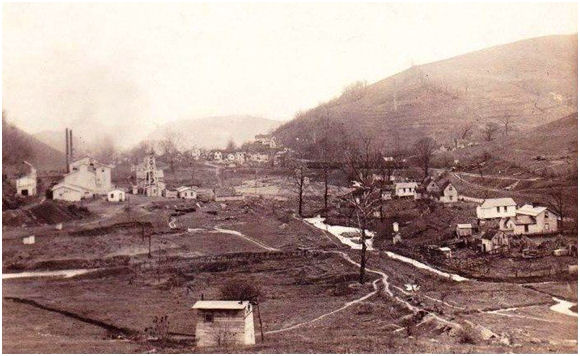
Plasterco Before 1924
These issues had been resolved by 1869 when
Palmer and Stuart reorganized the Salt Works
Corporation, which they capitalized with $1,000,000.00
cash. Soon
they had the works in production, employing two hundred
workers who were making thousands of bushels of salt.
This would necessarily imply that the Virginia
and Tennessee Railroad was up and running again.
Obviously flush with cash, Palmer rapidly bought
up bankrupt plantations in the Glade Spring area. Stuart
starting in 1868 took his capital and bought up the
fertile plantations across Clinch Mountain in Russell
County’s Elk Garden, laying the foundation for what was
to become the nation’s largest farm east of the
Mississippi, the Stuart Land and Cattle Company.
By the 1870 census he had acquired 100,000 acres
in Russell, Smyth, and Tazewell Counties. William
Alexander’s son, Henry Carter Stuart used the cattle
company to propel himself into the Governor’s mansion.
