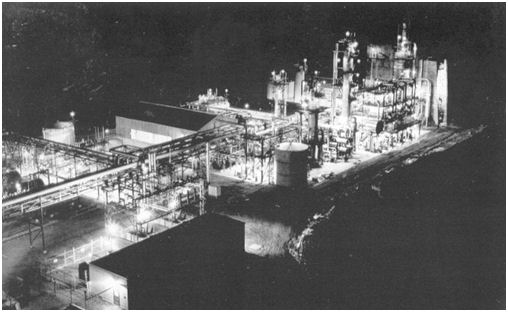
The Hydrazine Plant at Saltville
Calcium carbonate, and magnesium carbonate (the
magnesium occurs naturally within the limestone) and
various compounds of hydroxide are the natural waste
products of these processes.
Taken together, they are
nearly as erosive as lye, to which they are related.
This mixture was called
‘sludge’.
The river was rerouted so
as to create a large bottom on the north side.
Earthen dams were built
there to retain the sludge.
The highest dam was 100
feet high. A group of houses, called Palmertown, was
built across the river from this sludge pond dam.
On Christmas Eve 1924 this
dam gave way, releasing the sludge through a break 300
feet wide.
Nineteen people died in
this wall of lye like sludge.
The valley of the North
Fork was whitewashed for miles downstream.
In the 1960’s, even as the National Space and
Aeronautics Administration of the Federal Government was
encouraging Olin to make hydrazine, whose manufacture
produced the sludge, another Federal agency, the
Environmental Protection Agency, was becoming concerned
about mercury.
Mercury had been used for
centuries without concern for a wide variety of
processes, such as tanning, felt manufacture, laxatives,
syphilis treatment, and for thermometers and pressure
gauges.
Children played with it,
“turning” pennies into silver in the palms of their
hands.
But in the 1960’s it was
discovered that the simplest of organic molecules,
methane, would unite with mercury to make methylmercury,
and that this substance was taken in by a wide variety
of microscopic organisms, which in their turn were eaten
by snails, crawfish, and minnows, which in turn were
eaten by fish, which were eaten by humans.
The mercury caused
dementia, rashes, and death.
... Continue
to PAGE 56
