BOOK
NAVIGATION
Introduction
Earliest Settlement
The
Mansions of Elk Garden
The Great
Awakening
The Stuart Family
Lead, Salt,
& Cattle
Wealth
Leads to Politics
Addendae
Bibliography
Genealogies
Index
|
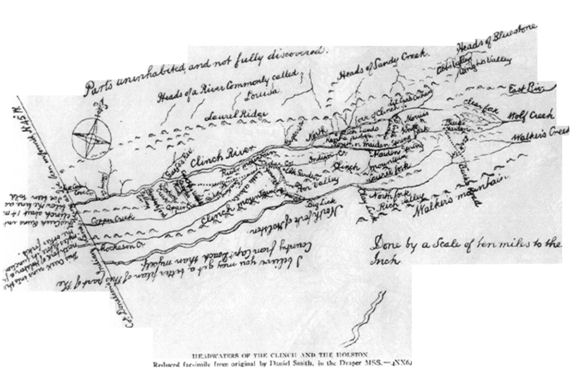
Daniel Smith’s’ Map of
Greater Elk Garden
continuing to the salt work at Saltville by
Hayter’s Gap, and the War Gap Trail that crossed War Gap Ridge
to State #619, which went to Saltville by Rich Mountain Gap.
The name ‘War Gap’ commemorates a battle between the
Shawnee and Cherokee as the latter strove to defend their salt
works. It is an
event parallel to a similar action at ‘Battle Mountain’ just to
the east.
The exact location of Elk Garden Fort is undocumented.
Contrary to the usual pattern, none of the land grants in
Elk Garden mention it.
Neither do any of the tracts of land sold or inherited
off of these grants mention its existence.
The descriptions of the sites of these frontier forts
always had certain characteristics, which are that they were
located on the Indian Trails that they were meant to interdict,
which usually meant that they were just to the north of a
significant gap in Clinch Mountain.
They were either on high ground, or at least were far
enough away from high ground that could not be threatened from
it. Most
importantly, there was always a good spring within rifle shot of
the fort. This
spring had to have a large enough flow to not only supply the
men, but also their horses and cattle.
This last requirement significantly limits the possibilities of
sites for the fort in Elk Garden.
As mentioned before, Elk Garden lays on a bed of
limestone. Most of the
surface water is drained off through either subterranean
caverns, or the giant fissure that runs the length of Dry Branch
Valley. The numerous
sink holes in Elk ...
Continued, Page 5. |
