|
link between the east and west of the
Confederacy. At that
point, Saltville became very critical.
At the beginning of the war Saltville had only
one salt furnace with 70 kettles.
In 1864 there were 38 furnaces with 2,600 kettles.
Salt was being produced faster than the railroad could
carry it off. 37 counties
and several states together ran 50 furnaces at Saltville.
In addition, one could see a thousand salt wagons lined
up at one time. At the
height of its significance, Saltville was supplying 80% of the
Confederacy’s salt.
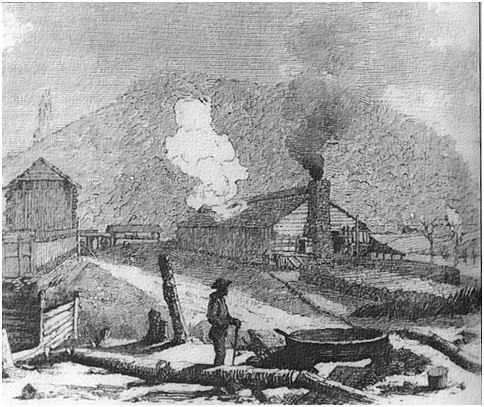
Civil War Era
"Lower Salt Works"
Palmer and Stuart geared up production at Saltville.
The company was called “Stuart and Company”, with Stuart
being its public face, and Palmer acting as the more active
internal manager. In 1864 they made 4,000,000 bushels of salt.
Not only was their company making as much salt as it
could, but individual Southern states set up their own salt
making facilities on the grounds of the company at Saltville.
Approximately 2,000 slaves were employed in making salt.
Allocation and rationing of salt rapidly became a contentious
reality.
The fact of
life was that there were three kinds of money in use in the
region during the war years.
There was Confederate paper money, which steadily lost
value as the war progressed, as well as gold, and Federal
“Greenback” paper money.
... Continue
to PAGE 34
33

Return to Big Stone Gap Publishing.com
Copyright © 2014 Lawrence J. Fleenor, Jr.
All Rights Reserved
|