|
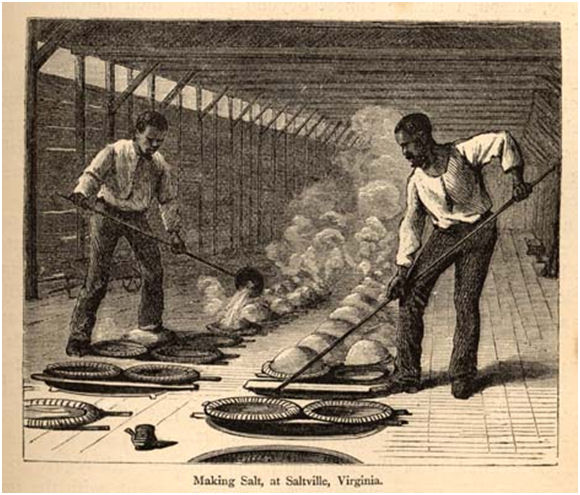
cost of salt.
Presumably, he paid the local plantation owners who
supplied the food and clothing with Confederate money.
In the 1860 census Stuart is listed as
having $12,000 in real estate, and $6,000 cash.
In 1870, despite the general economic disaster visited on
the Confederacy by the war, the census listed his estate as
having been $325,000 in cash equivalents, and $400,000 in real
estate.
This was
notwithstanding the loss of the economic value of his 2,000
slaves at an average price of $300 each.
At the end of the war, Palmer and Stuart as
well as the local plantations of Washington, Smyth, and Russell
Counties had all lost whatever wealth they had had tied up in
Confederate money.
The difference was that the plantation owners with whom they had
done business during the war were bankrupt, and Palmer and
Stuart still held considerable wealth in gold and in Union paper
money.
Palmer rapidly bought up bankrupt plantations in
the Glade Spring area. Stuart took his capital and bought up the
fertile plantations across Clinch Mountain ... Continue
to PAGE 36
35

Return to Big Stone Gap Publishing.com
Copyright © 2014 Lawrence J. Fleenor, Jr.
All Rights Reserved
|