|
Works until 1833.
It was White whom Toncray sued over
the shipping contract which was broken after the disaster of
1825.
The labor force at Saltville was slave labor.
It is unknown if any of the slaves were owned by the
company.
However, it
was common for plantation owners to lease slaves to industry.
This started as an off season process as planters sought
to gainfully employ their slaves during the winter.
Later slaves were leased around the calendar.
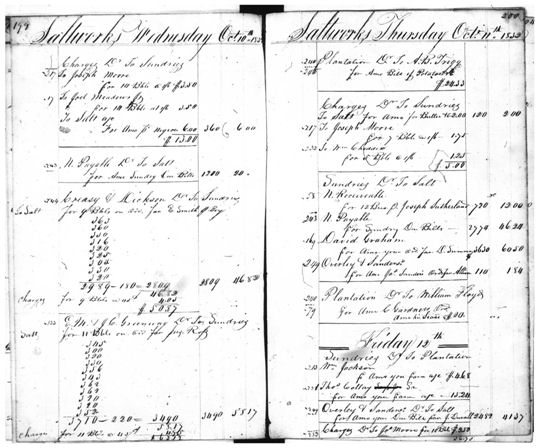
The account book of the Salt Works shows a line item for
Wednesday October 10, 1822 documenting money owed to Joel
Meadows, Jr. for 260 Negroes at a rate of $6.00 each.
The national competitive situation in the salt industry rapidly
changed in the two decades before the Civil War.
A large salt deposit at present Charleston, West Virginia
began to be industrially exploited in 1797.
It is located on the banks of the lower Great Kanawha
River, which leads directly to the Ohio-Mississippi-Missouri
River Systems.
This
position allowed the cheap transport via river steamer to much
of the interior of the developing country.
It is also in a region where there are large deposits of
coal which could be transported to the furnaces by water.
Pages From the 1822 Account Book of
the Saltworks
...
Continue
to Page 30
29

Return to Big Stone Gap Publishing.com
Copyright © 2014 Lawrence J. Fleenor, Jr.
All Rights Reserved
|