|
town at the head of
their troopers, a hail of shots came down upon them, and Toland
and others of his officers were killed.
The Union troops retreated to West
Virginia.
Not giving up on the
idea of destroying Saltville, Union troops tried again in
September that year.
They got within 35 miles of
Saltville, but were driven away.
In May 1864 Union
General Averell’s Cav. moved on Saltville.
When Averell learned that
Confederate General John Hunt Morgan and his ‘terrible men’ were
defending Saltville, Averell decided that it would be a better
idea to attack the Lead Mines instead.
Morgan, upon learning of Averell’s
moves, out maneuvered him and attacked the Union force at
Crockett’s Cove before it could get to Wytheville.
After a sharp fight, the Union
forces retreated to West Virginia.
In Sept. 1864 the Union
changed its route of invasion to the Big Sandy River in
Kentucky.
Starting at Prestonsburg Union
General Burbridge led his 5,200 mounted troopers, including the
5th US Colored Cav., up current US 460.
Burbridge had recruited his Black
Regiment by paying slave owners the average going price for
field hands, $300, for any slave that they allowed to enlist.
To add to the building dynamics of
the coming battle, Burbridge was the hated Union Military
Governor of occupied Kentucky.
The
route was very difficult, and if there had been adequate
Confederate defenders, very dangerous for Burbridge.
They moved through Laurel Gap, Va. in a thunderstorm.
Visibility was poor, the road muddy, and terrain
treacherous.
At
least 8 men and their horses fell to their deaths off of the
trail.
Many others
had to be rescued by ropes.
They spent the night at Maiden Spring, home of Reec
Bowen, who died leading his troops at the Battle of King's
Mountain.
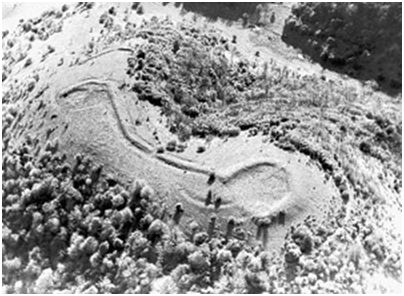
Confederate Earthworks At
Saltville
... Continue
to PAGE 38
37

Return to Big Stone Gap Publishing.com
Copyright © 2014 Lawrence J. Fleenor, Jr.
All Rights Reserved
|