|
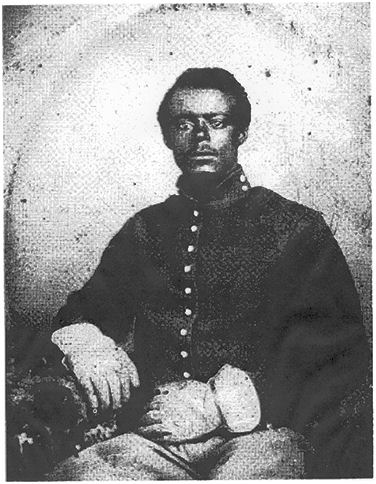
Samuel Truehart Who Fought at
Saltville with the
5th U.S. Colored Cav.
The Confederate defenders were under the
command of Gen. John Breckenridge, among whose troops was a
cavalry Capt. Champ Ferguson.
Breckenridge had been Vice
President of the United States.
These troops were also largely from
Kentucky.
The officer in charge of the onsite
defense was General Alfred E. “Mudwall” Jackson, who laid out
the earthworks.
Not knowing if the Union attack
would come from the west, as it later did with Stoneman, or from
the south, or the northeast, the entire Town of Saltville was
encircled with defensive forts and earth works.
To this day these earthworks are
admired as the best example of West Point textbook defensive
structures of that era yet in existence.
But Burbridge chose to descend the North Fork of the Holston
from near its source.
Even though the river meanders some within its narrow
valley, the valley itself is straight and unforgiving.
Clinch Mountain lies to its north, and Walker’s
Mountain to its south.
As the river and valley approach Saltville the
passage is further constricted by Little Mountain between
the river and Clinch Mountain, and Chestnut Ridge between
the River and Walker’s Mountain, where Cedar Branch crosses
the road. This
arrangement allows for no room for an attacking force to
maneuver, or to turn the defender’s flanks.
It was head on or nothing.
... Continue
to PAGE 39
38

Return to Big Stone Gap Publishing.com
Copyright © 2014 Lawrence J. Fleenor, Jr.
All Rights Reserved
|